Skip to content
POS Systems

BooksPOS

Book depot & stationery POS

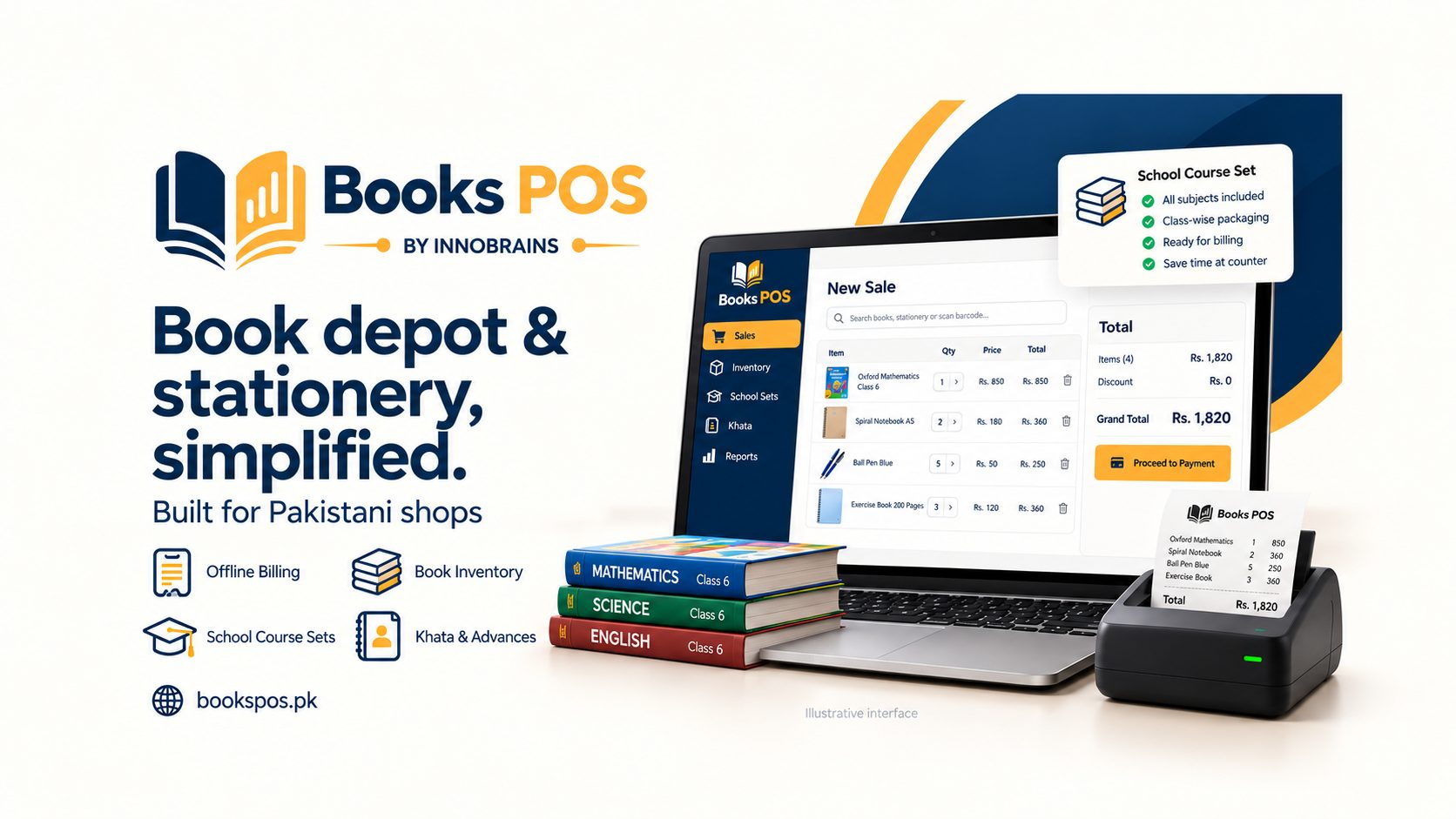
BooksPOS is Windows point-of-sale and stock software for book depots, stationers and school uniform shops in Pakistan. It runs on the shop's own PC and keeps billing when the internet does not, because a queue at the counter in school season cannot wait for a connection.

It is built around the three things that break ordinary POS software in this trade. Books are held per edition, so last year's print and this year's are separate items with separate stock. Stationery sells by piece, dozen, box, ream or carton from the same stock, with pack barcodes. Uniforms are entered by size in one go — type the sizes once and every one is created, with a single price filling them all and a dearer size changed by hand.

School season is where it earns its keep. Course sets hold a class list per school, session and section, with items marked compulsory, optional or consumable. At the till, F6 adds the whole ticked set with its discount and orders whatever is out of stock. Advances paid by parents are held against their name and used on later bills, and reservations hold copies until a date you set.

Behind the counter it keeps real books, not just a sales total: every posting is a balanced journal entry, with a day book, trial balance, profit and loss, and a daily sales report carrying cost of goods sold. Purchase orders, publisher returns as credit notes, consignment stock that stays the publisher's until sold, godown and shop-floor stock, and khata with credit limits all live in the same system.

It comes in two editions. The Cloud edition syncs each branch to an owner portal and a free Android owner app, so sales, stock and khata across up to three branches can be checked from anywhere, with transfers between them tracked. The Offline edition is a one-time lifetime licence for a single shop whose data never leaves its own PC.

For Tier-1 retailers, FBR POS integration reports each sale as it is billed and prints the FBR invoice number, QR code, NTN, STRN and POS ID on the receipt. Bills made while FBR is unreachable print as offline invoices and are resent automatically. It stays switched off, with no FBR fields and no fee, until you turn it on.
What it does

  • Keyboard-first till — scan, or search by title, author, code, ISBN or Urdu text
  • Books by edition, each with its own stock
  • Stationery by piece, dozen, box, ream or carton, with pack barcodes
  • School uniforms by size, entered in one go
  • School course sets — press F6 to add a whole class list
  • Advances from parents, held and used on later bills
  • Khata with credit limits, statements and payments
  • Purchase orders, publisher returns and consignment stock
  • Godown and shop-floor stock, with transfers between branches
  • Day book, trial balance and profit and loss that balance
  • ISBN check-digit verification; EAN-13 and Code 128 barcode labels
  • FBR POS integration with invoice number and QR on the receipt
  • Owner portal and free Android owner app (Cloud edition)
  • Works offline; changes sync when the connection returns

More products

POS Systems Rs. 30,000

AgroPOS

Agriculture POS Software

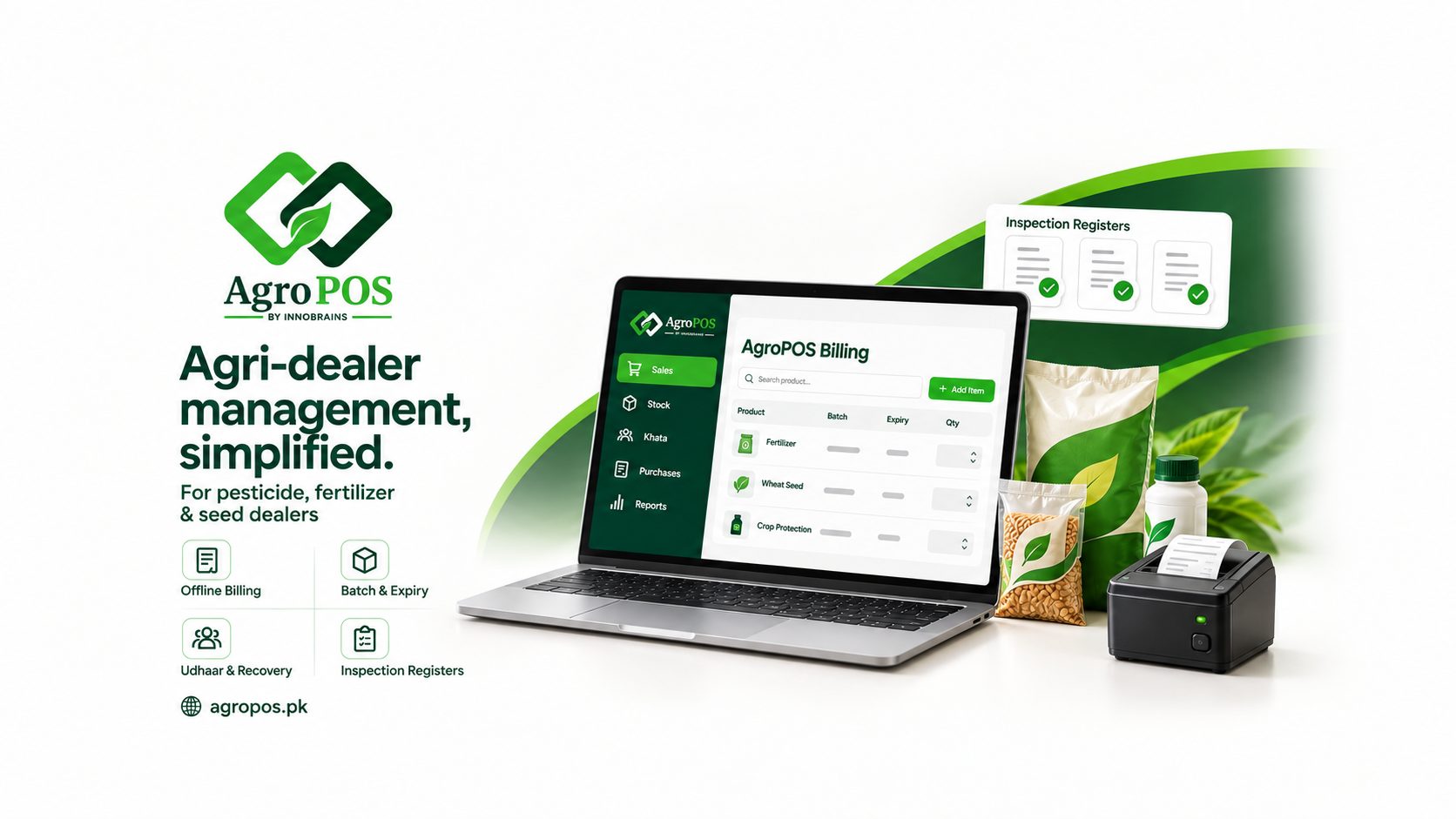
Windows POS and inventory software for pesticide, fertiliser and seed dealers in Pakistan — batch-wise expiry tracking, farmer udhaar khata, Agriculture Department inspection registers and fully offline billing.

Windows Desktop (10 / 11, 64-bit) SQLite (local database) Encrypted cloud backup Android companion app
POS Systems From Rs. 23,750

MediPOS

Pharmacy POS — offline or cloud

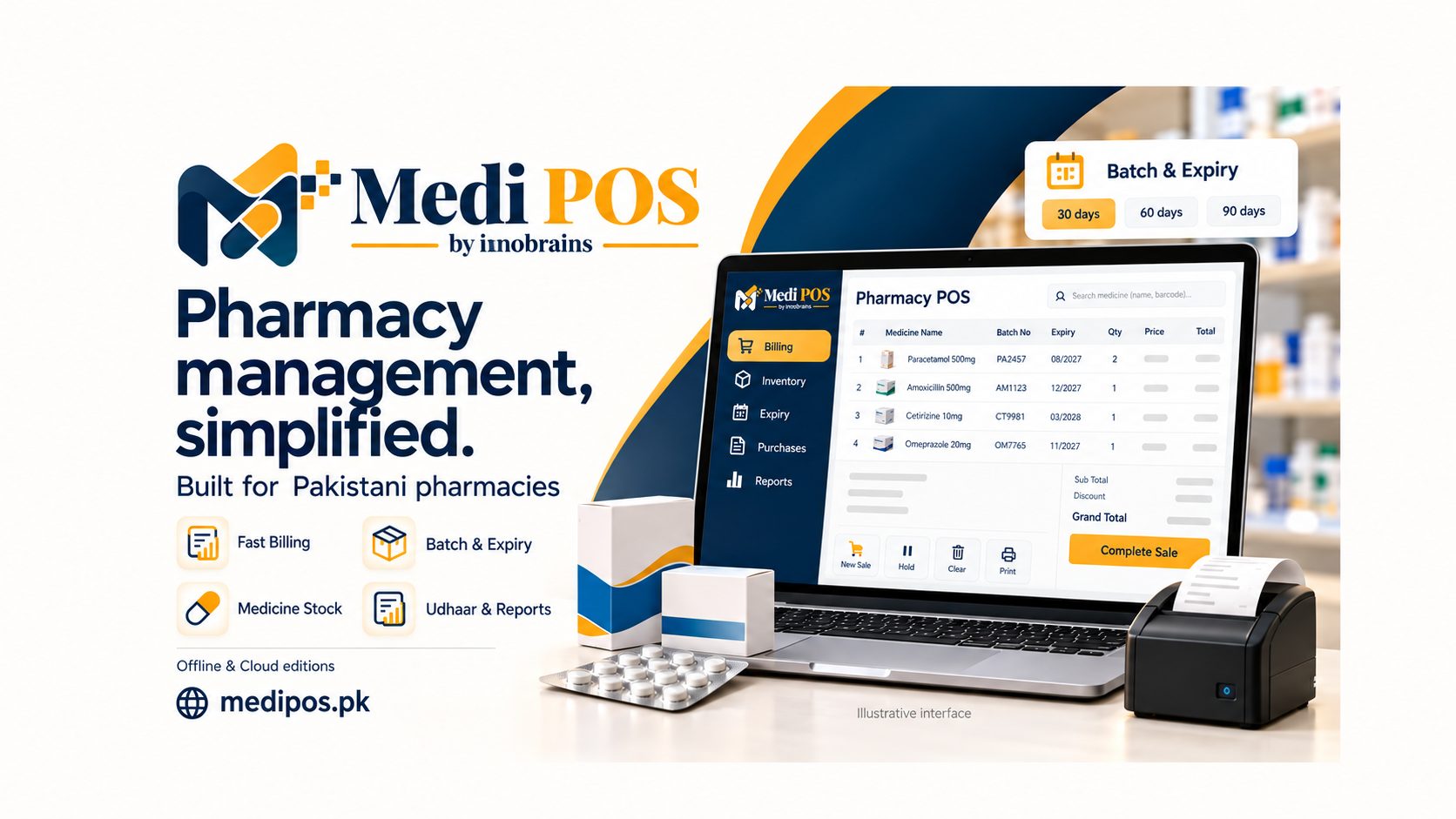
Pharmacy billing, stock and accounts for Pakistan: a cloud edition billed yearly or monthly, or a one-time lifetime licence that runs offline on your own shop computers.

Electron React TypeScript Vite
FAQ

Questions about BooksPOS

It depends which edition you want. The Cloud edition is billed yearly or monthly and adds the owner portal and owner app: Rs 17,500 a year for one till, Rs 30,000 for up to five tills, and Rs 45,000 for up to three branches with transfers between them (an extra branch is Rs 12,500 a year). Paying yearly saves about 16% against monthly. The Offline edition is a one-time lifetime licence with no yearly fee: Rs 24,999 for one till or Rs 34,999 for up to five. Every plan starts with a 14-day free trial and there is no setup fee.

Yes. The shop's own Windows PC runs the store server and owns that branch's data, so selling, returns, purchases, khata payments, closing a shift and printing all carry on with no connection. On the Cloud edition changes queue up and sync roughly every fifteen seconds once the internet is back. One thing to know: a till running on a second PC needs the shop network to reach the store PC, though the till on the store PC itself keeps working regardless.

That is what it was built for. A course set holds a class list per school, session and section, with each item marked compulsory, optional or consumable, and alternatives grouped so a parent can choose. At the till you press F6, tick what the parent is taking, and the whole set goes on the bill with its discount — anything out of stock is ordered at the same time, and handed over later against the advance.

Yes, and neither needs a separate item per variant. Uniform sizes are typed once and every size is created together, with one price filling them all and a dearer size changed by hand; the till then asks which size, showing price and stock for each, and size barcodes can be printed. Stationery sells by piece, dozen, box, ream or carton from the same stock, with a barcode per pack.

Yes. Each edition or format is a separate item with its own stock, so last year's print and this year's are never confused at the till or in a stock count. ISBN is optional, and when you enter one its check digit is verified; items without an ISBN get an internal code, and labels print as EAN-13 for a valid ISBN or Code 128 for an internal one.

Yes, for Tier-1 retailers. Each sale goes to FBR right after it is saved, through their online API or the Fiscal Component, and the receipt carries the FBR invoice number, QR code, your NTN, STRN and POS ID. Returns are reported as credit notes against the original invoice, and bills made while FBR is unreachable print as offline invoices and are resent automatically. It stays switched off — no FBR fields, no fee — until you turn it on in Settings, so a shop that is not Tier-1 sees none of it.

On the Cloud edition, yes. There is a free Android owner app showing each branch's sales, bills, profit and returns against yesterday, the last 30 days and this month, along with floor and godown stock, customer receivables and supplier payables, and alerts for low stock or a branch that has gone quiet. It is protected by a two-step code and a fingerprint or PIN lock. There is no iPhone app yet, and the Offline edition has no portal or app.

Yes — 14 days, with no card required. Download the Windows installer and pair the store PC with your account; we check each new business first, and the trial starts once it is approved. When it ends nothing is deleted. Items, customers and suppliers can be imported from CSV, which has been tested with fifty thousand rows, so you can try it on your own catalogue rather than a demo one.

Yes, and there is no setup fee. We help you install it, bring in your item list, customers and opening balances, and train whoever stands at the counter. After that you can reach us on WhatsApp or the phone, from our own team in Jhang — Monday to Saturday, 10:00 to 19:00. There are also eighty-odd written guides at bookspos.pk/docs covering everything from the first install to closing the books.